Set up?
Does the local evidence justify the effort and energy?
Field-built environmental intelligence
EDS observes changing local conditions, estimates near-term environmental risk and supports reviewable decisions for weather-sensitive operations.
Local evidence becomes a reviewable decision.
Temperature · humidity · pressure · light
Timestamped context
Now · 1 h · 3 h
Reasons visible
The decision gap
For astronomical observing, the useful window can change faster than a broad forecast suggests. Humidity can tighten toward the dew point. Local light and pressure can shift. A false positive wastes setup time and energy; a false negative can waste a rare clear interval or leave equipment exposed.
EDS began with a practical need: decide whether to begin, continue or stop an observing session. It also needed to provide earlier warning of conditions that could threaten optics and remote equipment.
Does the local evidence justify the effort and energy?
Is the trajectory stable enough to keep observing?
Is dew or rapidly changing weather becoming a risk?
Should the operator fail closed rather than assume safety?
Measure locally. Preserve the history. Make the uncertainty visible.
One continuous system
A weather station reports conditions; a dashboard displays them. EDS preserves the local history, interprets near-term risk and keeps the resulting decision state reviewable by an operator.
Local temperature, humidity, pressure, ambient light, battery state and signal health.
Maintained field stationTimestamped telemetry, latest state, history, aggregates, gaps and staleness.
Reviewable local recordCurrent-condition rules and 1-hour / 3-hour advisory risk windows.
Confidence stays visibleOperator views, policy state, reasons, events and proposed actions.
Advisor and dry-run todayThe operating loop
Each stage preserves enough context to show what changed, what the system inferred, and why a conservative hold may be safer than a confident-looking answer.
Verified scope
Minute-scale MQTT telemetry, retained station status, bounded offline buffering, historical records and station-health checks.
Latest observations, raw history, aggregates and client-side replay views keep trajectories available for review.
Policy, state, reasons, overrides, events and proposed actions are available in advisor or dry-run workflows.
Supported local measurements are available through a partial ObservingConditions surface; wind, rain-rate and cloud-cover properties are not implemented.
Advisory forecast rail
The 3-hour value represents the highest or worst assessed class within the next three hours. It does not predict an exact event time. Outputs are advisory and trained against rule-derived labels.
Candidate models are evaluated offline and must pass controlled release gates before they can influence operational guidance.
The safety state machine can propose actions. Direct hardware execution and a verified N.I.N.A. workflow remain future work.
The software can represent multiple stations. A validated distributed physical network and external weather-feed ingestion have not yet been demonstrated.
Where local truth matters
The current evidence base is strongest for one coastal station and weather-sensitive astronomical operations. Other uses require their own sensors, thresholds and validation.
Session go/no-go guidance, dew awareness, equipment protection and remote-site context.
Persistent local observations and a reviewable record around an event or experiment.
Environmental and station-health context for systems that cannot be watched continuously.
An end-to-end testbed for sensing, data engineering, model governance and inspectable decisions.
Evidence from the field
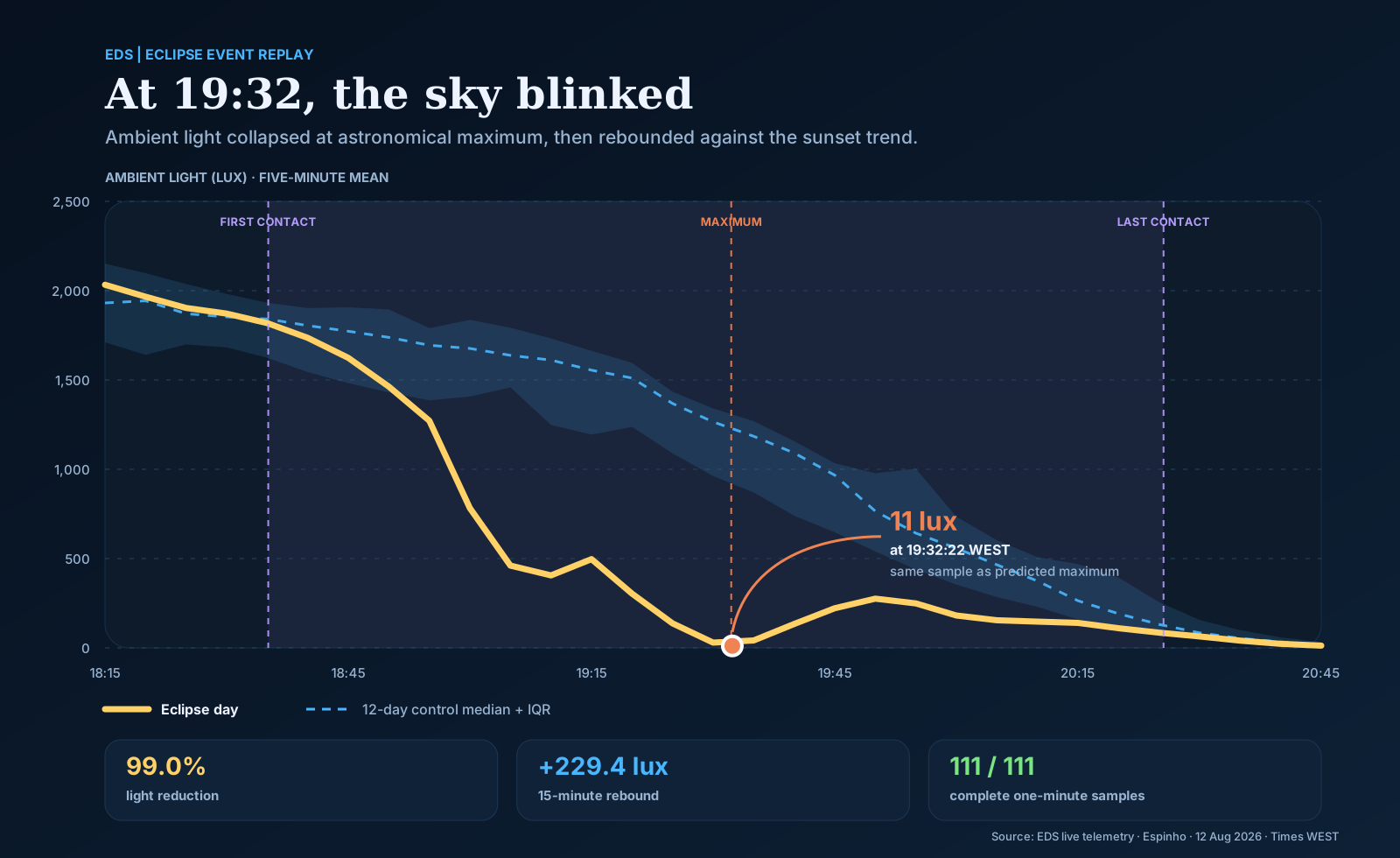
One record examines a precisely timed astronomical event. The other examines continuity and repeated local pressure transitions across an extended winter sequence.
Can EDS preserve and explain a precisely timed environmental event?
Can EDS preserve repeated local atmospheric transitions across an extended winter sequence?
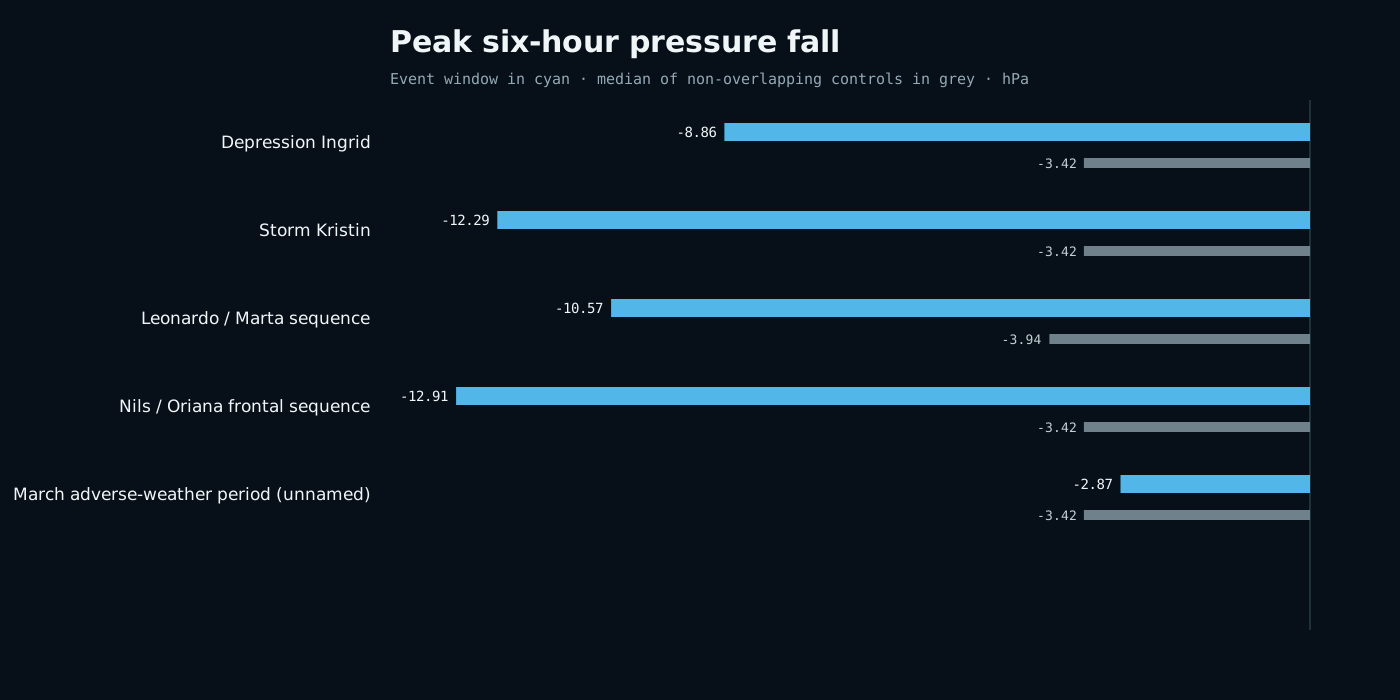
The dashed 10 hPa line is the frozen event-screening threshold used by this field note. It is not a national warning, storm-classification, or forecast threshold.
Field hardware + operations
The system joins physical design, embedded firmware, telemetry transport, storage, advisory models, operator tooling and operational policy. Each layer matters only when the chain preserves the meaning and quality of the observation.
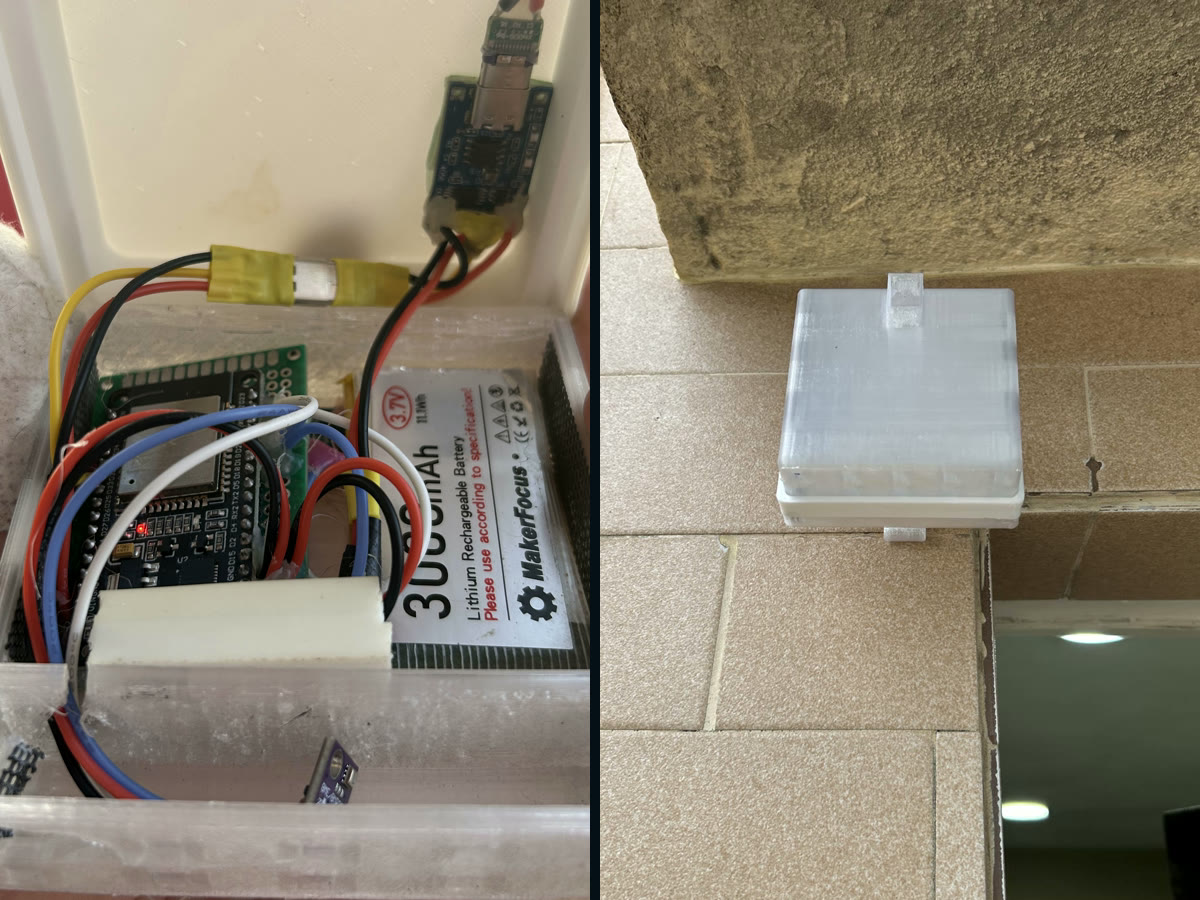
Post-event documentary views of the maintained environmental observer, including its electronics enclosure and weather-facing housing. They provide hardware context, not eclipse-day evidence.
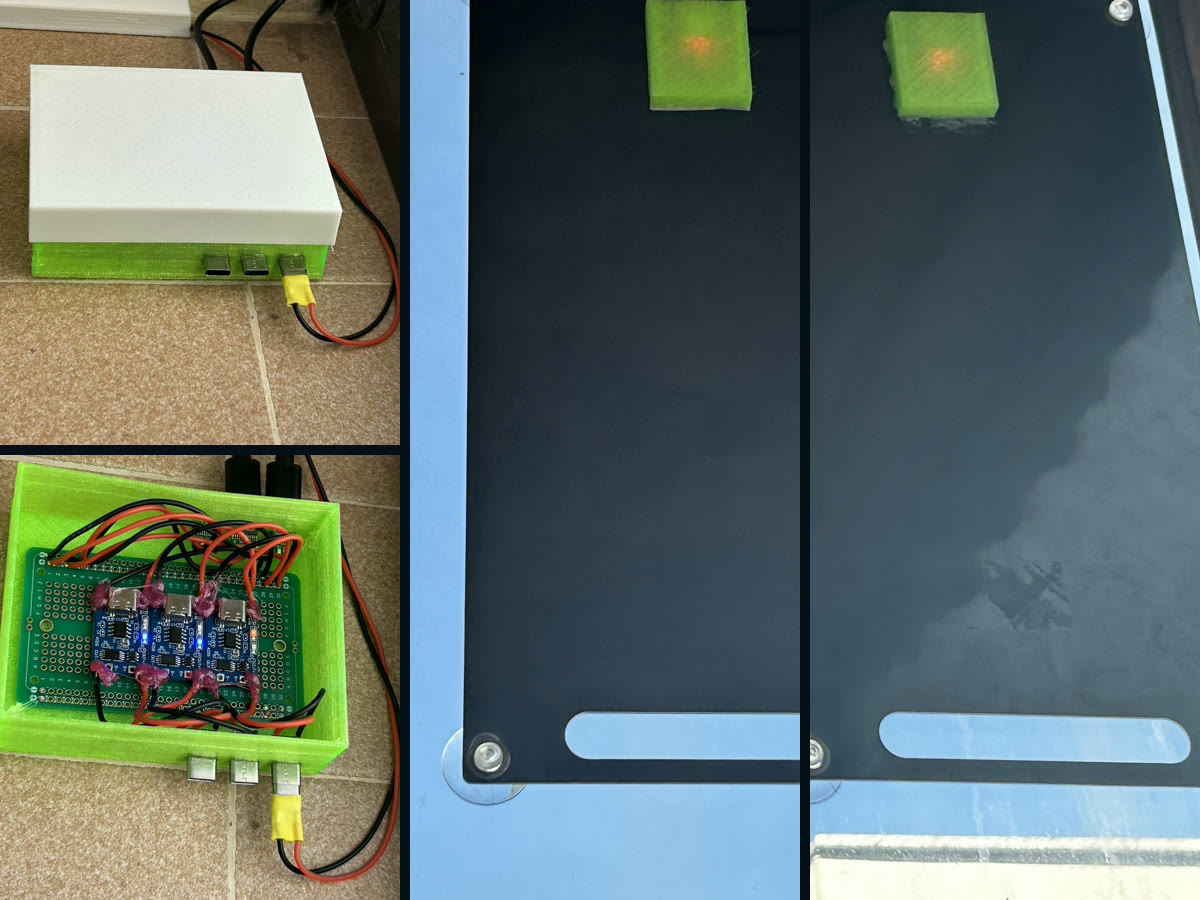
Two compact solar panels feed a separate custom power-management and distribution unit used by the field installation. The green enclosure belongs to the power subsystem, not to the environmental station.
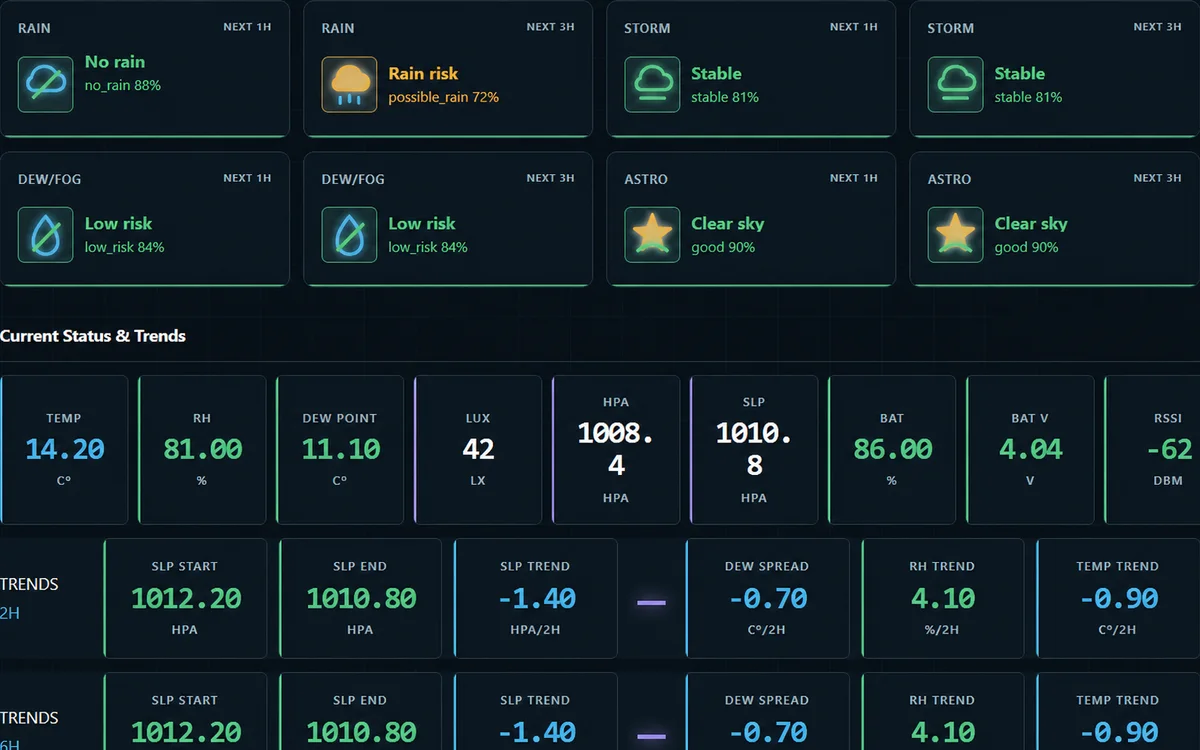 Representative QA capture · fixture values · not live
A sanitized QA capture shows the current operator surface joining 1-hour and 3-hour guidance, current conditions and trends. Its values are representative fixtures, not live station data.
Independent R&D by MDNT
EDS is engineered by Teófilo Couto as an independent MDNT research and development system spanning station hardware, firmware, data services, model evaluation, operator tooling and field publication.